Water Lilies
Listen by age
- Ages 4–7 Sign in to preview Gentle looking, simple words, one small detail to find.
- Ages 8–12 Sign in to preview More clues about composition, artist choices, and visible evidence.
- Teens & Families Sign in to preview Context and discussion prompts for older kids and adults together.
About Water Lilies
Where did the sky go?
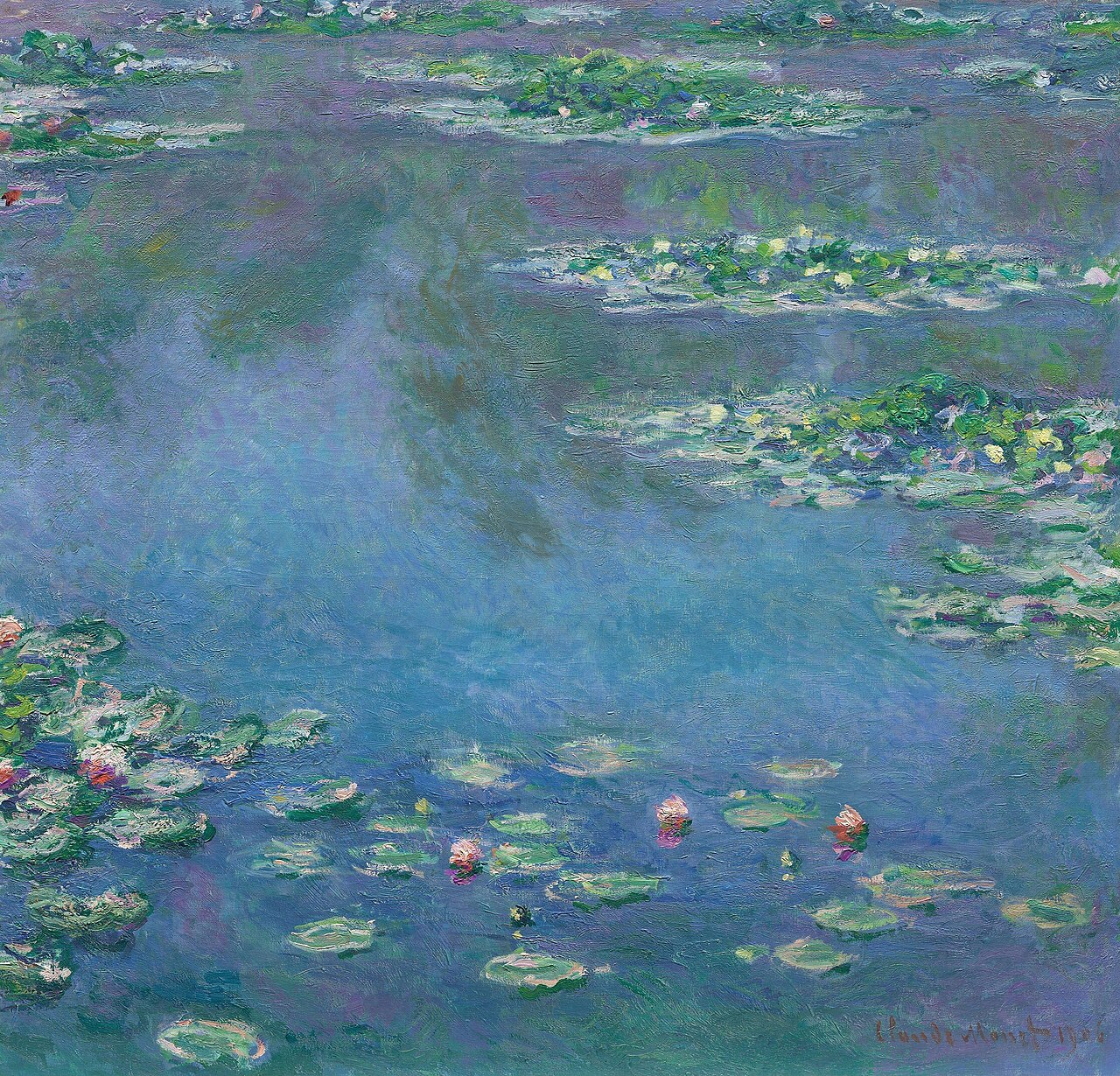
In most landscapes, the sky stays above your head and the ground stays below your feet. Monet’s pond refuses to behave that way. There is no horizon and almost no shore. The water stretches to every side, carrying lily pads, patches of light, and reflections of things we cannot see.
Choose one pale shape. Is it a flower floating on the pond, a cloud reflected in it, or a flash of sunlight? The longer you look, the harder it becomes to separate what is on the water from what is mirrored inside it.
Monet knew this pond well. He helped create the water garden at his home in Giverny, then painted it again and again. In this 1906 painting, he lets us borrow his favorite view—but removes the clues that would normally tell us which way is up.
Artwork details
- Artist
- Claude Monet
- Date
- 1906
- Medium
- Oil on canvas
- Dimensions
- 89.9 × 94.1 cm
- Collection
- Art Institute of Chicago
- Accession number
- 1933.1157
Sources & rights
Claude Monet, Water Lilies, 1906. Art Institute of Chicago, Mr. and Mrs. Martin A. Ryerson Collection, 1933.1157. Digital image courtesy of the Art Institute of Chicago.