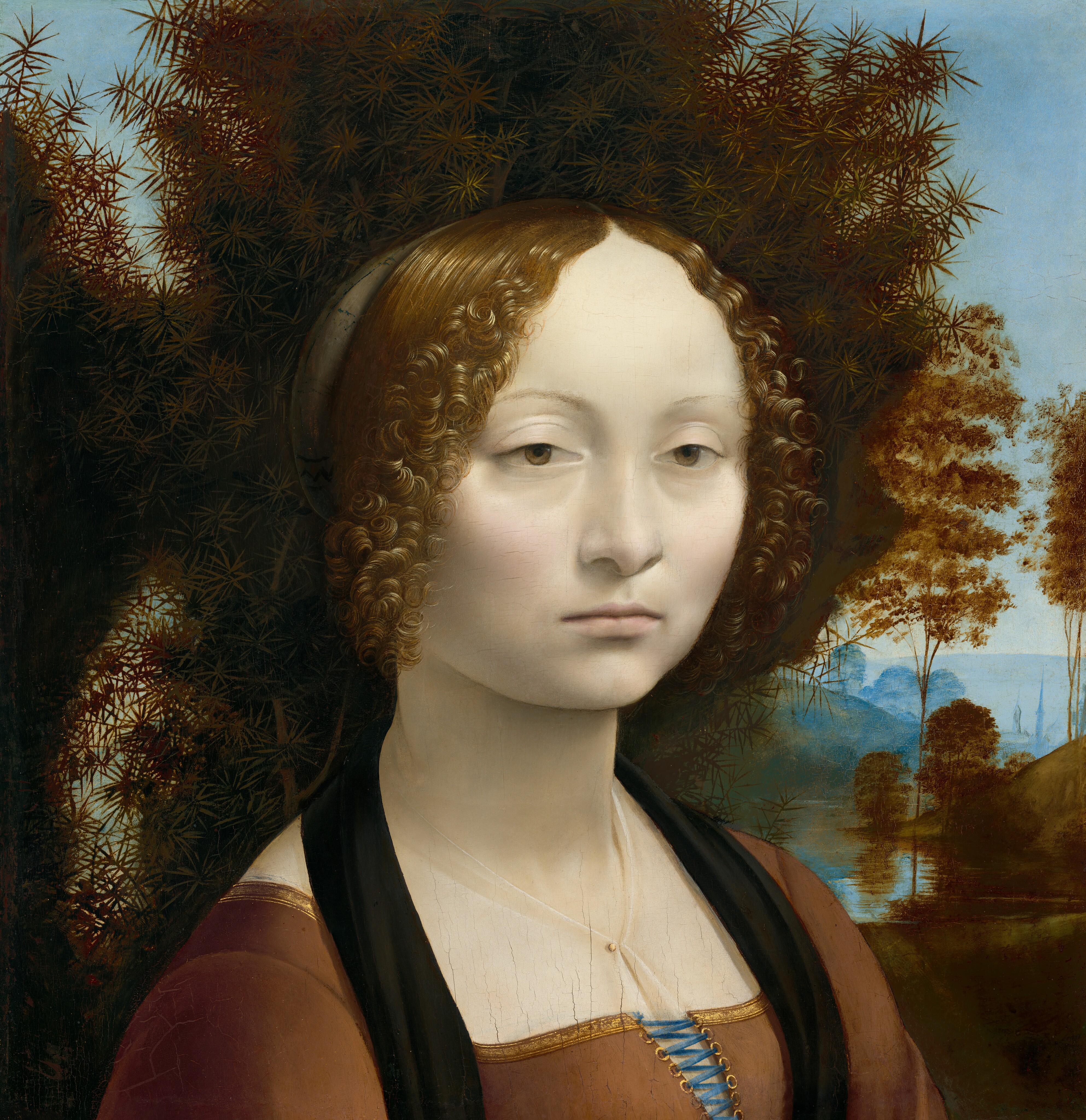
Ginevra de’ Benci
Listen by age
- Ages 8–12 Sign in to preview More clues about composition, artist choices, and visible evidence.
- Teens & Families Sign in to preview Context and discussion prompts for older kids and adults together.
About Ginevra de’ Benci [obverse]
Leonardo has hidden Ginevra’s name in plain sight.
The dark green plant behind her is juniper. In Italian, juniper is ginepro, a word that sounds like Ginevra. It is a quiet visual joke—and a clue to the identity of this serious young woman, painted in Florence when she was about sixteen.
Ginevra does not smile for us. She does not seem worried about appearing friendly, either. Her face can look calm from one angle and distant from another, which makes the portrait feel less like an answer and more like meeting someone for the first time.
Leonardo also turned her slightly toward the viewer instead of showing only a strict side view, as many Italian portraits of women did. Behind her, water and land fade into pale distance.
Part of the panel was cut away long ago. The portrait is incomplete, but Ginevra’s steady presence is not.
Artwork details
- Artist
- Leonardo da Vinci
- Date
- c. 1474
- Medium
- Oil on panel
- Dimensions
- Original panel 38.1 × 37 cm
- Collection
- National Gallery of Art
- Accession number
- 1967.6.1.a
Sources & rights
Image courtesy National Gallery of Art, Washington; public domain/open access.