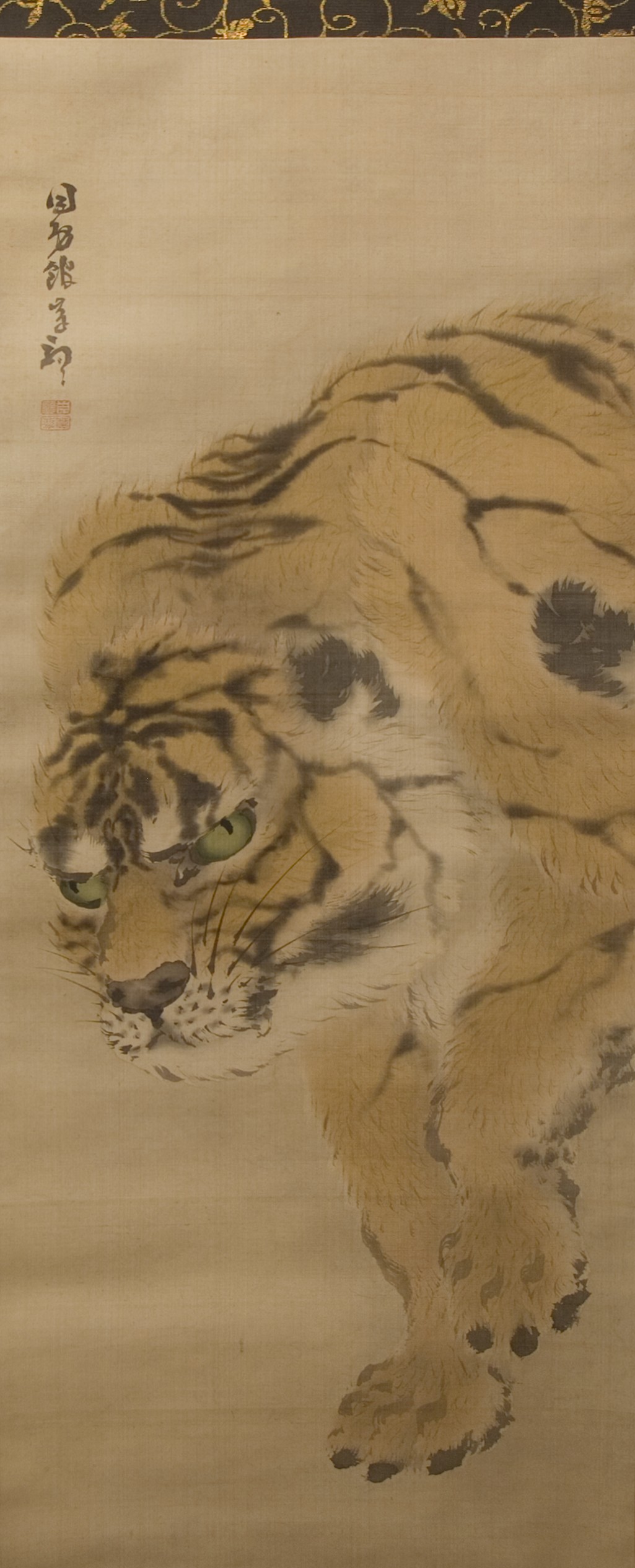
Tiger
Listen by age
- Ages 4–7 Sign in to preview Gentle looking, simple words, one small detail to find.
- Ages 8–12 Sign in to preview More clues about composition, artist choices, and visible evidence.
- Teens & Families Sign in to preview Context and discussion prompts for older kids and adults together.
About Tiger
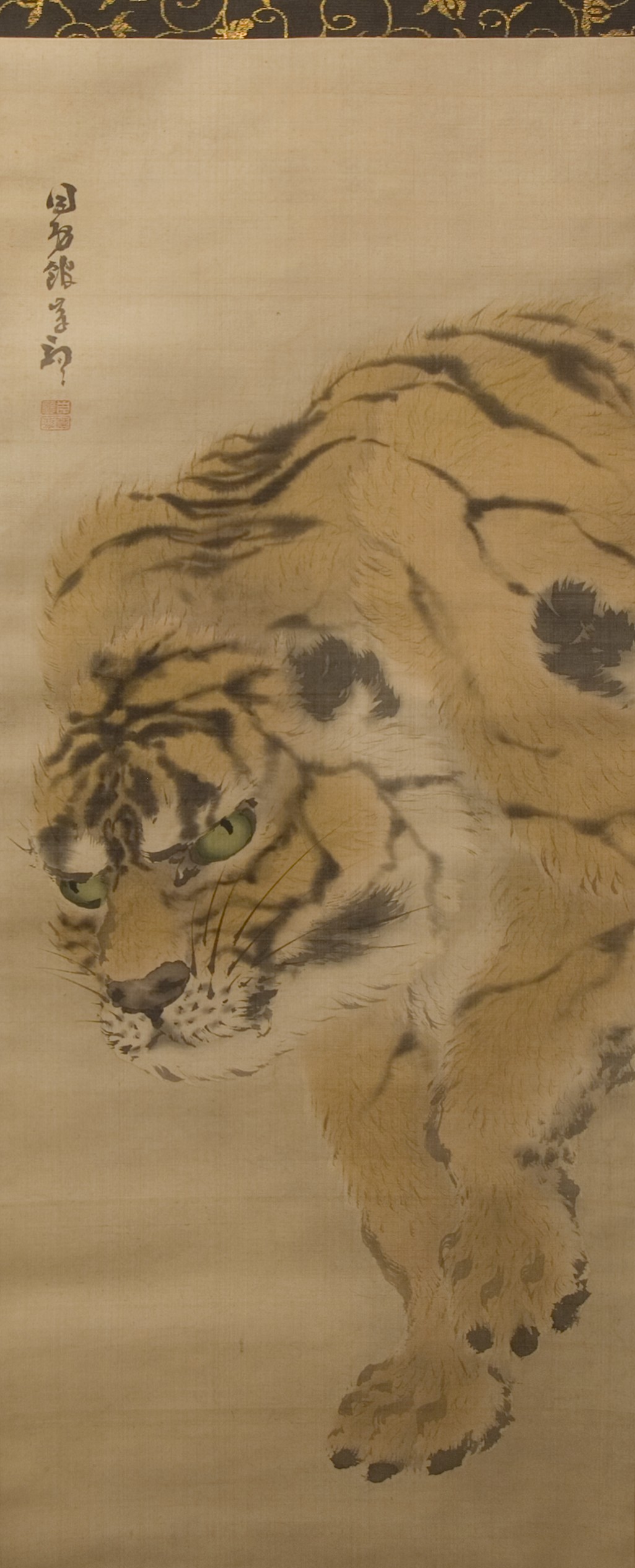
Gan Ku’s tiger looks ready to spring—and a little like a creature from someone’s imagination.
Its broad back curves through the tall, narrow scroll. Heavy paws grip the ground. Fine brushstrokes build thick fur, while the round face turns toward us with an expression that is fierce, alert, and oddly thoughtful.
Gan Ku worked in Japan in the early nineteenth century, when most Japanese artists had little chance to study a living tiger. He learned from older Chinese and Japanese painting traditions. Then he used his brush to make the tiger feel present.
That is why some parts seem wonderfully convincing while others do not look quite like a wildlife photograph. This animal carries two kinds of truth at once: the weight and energy of a tiger, and the picture of “tiger” that travelled through many artists’ hands.
It is not less interesting because imagination helped build it. Imagination is part of its history.
Artwork details
- Artist
- Gan Ku
- Date
- early 19th century
- Medium
- Hanging scroll; ink and color on silk
- Dimensions
- 106.7 × 41 cm
- Collection
- The Metropolitan Museum of Art
- Accession number
- 36.100.11